For Research Use Only. All content on RegisteredPeptides.com is intended for qualified researchers and licensed laboratory professionals. Products referenced are not for human or veterinary use and have not been evaluated by the FDA.
How to Read a Peptide Certificate of Analysis (CoA)
By RegisteredPeptides.com · June 2026 · 6 min read · Laboratory Standards / Quality Assurance
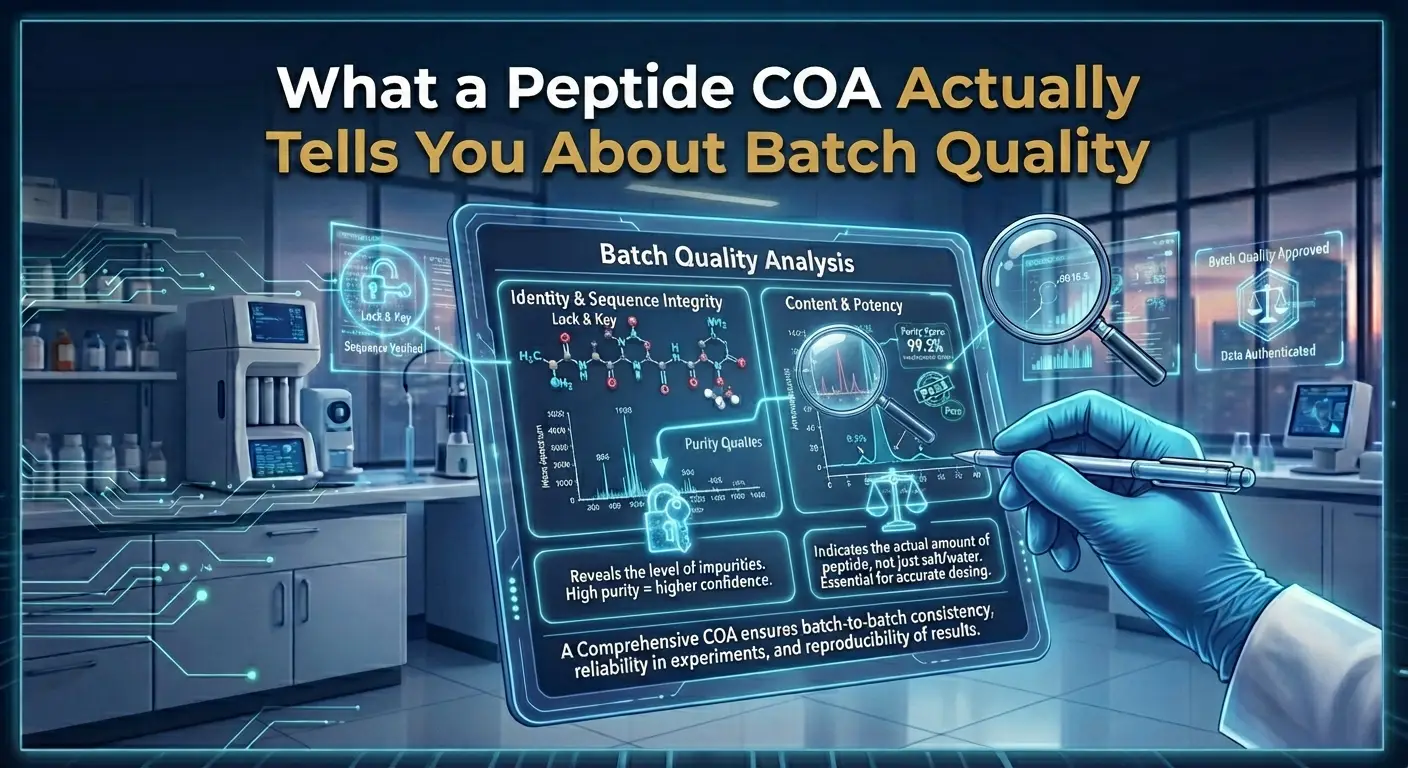
A Certificate of Analysis (CoA) is the primary document through which a peptide supplier communicates the analytical characteristics of a specific product lot. For researchers, the CoA is not simply a compliance formality — it is a critical tool for evaluating whether a compound meets the quality threshold required for your application and for maintaining accurate laboratory records.
Despite its importance, CoA documents are frequently misread or ignored. This guide walks through each section of a standard peptide CoA and explains what the data means for your research.
1. Product Identification Fields
The top section of a CoA contains identifying information for the specific product and batch. Key fields to verify:
- Compound name and catalog number: Confirm these match your order exactly. Catalog numbers are unambiguous; product names can vary between suppliers;
- Amino acid sequence: The full one-letter or three-letter amino acid sequence should be listed. Verify this matches the sequence you intended to order — even a single transposition is significant in biological research;
- Molecular formula and molecular weight: Should be consistent with the stated sequence. Discrepancies here are a red flag;
- Lot or batch number: Each production batch should have a unique identifier. A CoA without a lot number is a generic document, not a lot-specific analysis — treat it with skepticism;
- Manufacture date and expiration or retest date: Important for planning storage and use timelines.
2. HPLC Purity Data
The HPLC section is typically the most prominent analytical result on a peptide CoA. What to look for:
- Purity percentage: Expressed as a percentage of the target peak area relative to total integrated peak area. Common thresholds are >95% and >98% for research-grade material;
- Detection wavelength: Most peptide CoAs report purity at 220 nm, which captures the peptide bond chromophore and gives a relatively sequence-independent signal. Some CoAs report at 214 nm or 254 nm — be aware that different wavelengths yield different purity values for the same sample;
- Column type and mobile phase: A complete CoA specifies the HPLC column (e.g., C18, 4.6 × 150 mm, 5 μm) and gradient conditions. This allows you to replicate or verify the analysis in your own facility if needed;
- Chromatogram: Ideally, the raw chromatogram should be included or available upon request. A single dominant peak with a clean baseline indicates high-purity material. Multiple peaks or a elevated baseline suggest significant impurity content.
Important: HPLC purity is a relative measurement — it tells you what fraction of the detectable material is your target compound, but it does not identify the impurities. A purity of 97% means 3% of the signal comes from other species, which may include truncated sequences, oxidation products, or synthesis byproducts. For sensitive assays, understanding the identity of those impurities may matter.
3. Mass Spectrometry (MS) Confirmation
Mass spectrometry data provides identity confirmation independent of the HPLC purity result. Key data points:
- Calculated molecular weight: The theoretical MW based on the amino acid sequence and any modifications;
- Observed molecular weight (MH+ or [M+H]+): The mass detected by the instrument. For ESI-MS, peptides are typically observed as multiply charged ions; the reported m/z values should be consistent with the calculated MW after accounting for the charge state;
- Mass accuracy: A high-quality CoA from an instrument with good mass accuracy should show the observed mass within ±0.1–1.0 Da of the calculated mass for smaller peptides. Higher-resolution instruments (e.g., Orbitrap-based MS) should achieve sub-ppm accuracy;
- MS spectrum or table: Raw spectrum data or at minimum a table of observed m/z values and corresponding charge states should be included.
If the observed mass does not match the calculated mass, this is a serious concern requiring clarification from the supplier before the compound is used in any experiment.
4. Physical Characterization
Beyond purity and identity, a complete CoA typically includes:
- Appearance: Expected physical description (e.g., “white to off-white lyophilized powder”). Significant deviation from this description — unusual color, oily residue, or clumping — warrants attention;
- Net peptide content / counterion correction: The percentage of the weighed material that is actual peptide, as opposed to residual water, TFA counterions, or salt. A peptide with 80% net peptide content means 20% of the mass is non-peptide material. This is important for accurate concentration calculations and is often absent from lower-quality CoAs;
- Solubility recommendation: Some CoAs include a recommended reconstitution solvent based on the compound’s physicochemical properties.
5. Storage and Stability Information
A well-prepared CoA will include compound-specific storage recommendations:
- Recommended storage temperature for lyophilized material (typically −20°C or −80°C);
- Stability in solution (some peptides have a known solution half-life);
- Any special handling requirements (e.g., light-sensitive compounds, air-sensitive thiol groups).
Red Flags in CoA Documentation
When evaluating a supplier’s CoA, the following are signs that analytical standards may not meet research-grade requirements:
- No lot number — indicating the document is generic and not batch-specific;
- Purity listed without a chromatogram or disclosure of HPLC conditions;
- No mass spectrometry data;
- Observed mass significantly deviating from the theoretical mass with no explanation;
- Purity assessed at a non-standard wavelength without disclosure;
- No net peptide content disclosure (particularly for quantitative experiments).
RegisteredPeptides.com provides lot-specific CoAs including HPLC and MS data with every order. Additional raw analytical data is available upon request for customers requiring deeper characterization documentation.